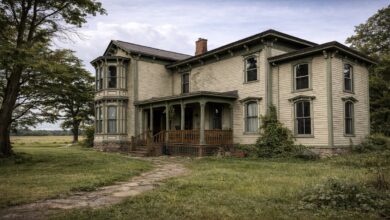
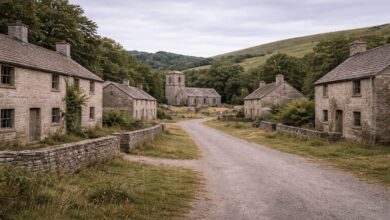
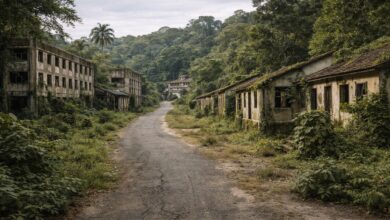
Set within the rural landscape of Norfolk, Raynham Hall has long been associated with Britain’s landed aristocracy. Built in the early 19th century and held by the same family for generations, the house is best known for its architecture, its collections, and its role in regional history. Yet Raynham Hall occupies a distinctive place in cultural memory for another reason: its association with one of the earliest widely circulated photographs claimed to depict an apparition.
The legend does not replace the hall’s documented past. It exists alongside it. Understanding Raynham requires examining how aristocratic life, early photography, and public fascination converged in a period when images began to carry authority previously reserved for written records.
An estate rooted in lineage
Raynham Hall was constructed in the 1720s as the seat of the Townshend family, prominent figures in British political and social life. The house exemplifies Palladian influence adapted to English country estates, emphasizing balance, symmetry, and restraint.
Unlike medieval castles designed for defense, Raynham was built to express stability and status. Its layout favors reception rooms, galleries, and staircases intended to impress visitors and support social ritual.
The hall functioned as both residence and symbol. It represented continuity of lineage rather than momentary power. Similar human responses to silence and environment appear in Château de Brissac.
Life within an aristocratic framework
For centuries, Raynham Hall operated within the rhythms typical of noble estates. Seasonal occupation, managed lands, and social obligations defined daily life. The house hosted gatherings, political discussions, and extended family networks.
Such environments were governed by hierarchy and decorum. Personal affairs were often subordinated to reputation and inheritance. Privacy existed, but it was constrained by expectation.
These conditions form the social background against which later legend emerged.
The figure at the center of the story
The apparition most commonly associated with Raynham Hall is known as the Brown Lady or Lady Dorothy Walpole. Dorothy Walpole was a real historical figure, married into the Townshend family in the early eighteenth century.
Accounts suggest that her marriage was unhappy and marked by restriction. She died relatively young. Contemporary documentation confirms her existence and death, but details of her personal life are incomplete.
This incompleteness created space for later interpretation.
Legend without a fixed origin
Stories of an apparition at Raynham circulated for decades before photography entered the narrative. Visitors and household members described sightings of a female figure in brown attire, often on the staircase.
These accounts were inconsistent in detail and spread primarily through oral retelling. Like many estate legends, they served as atmospheric additions to a place already defined by age and status.
At this stage, the legend functioned as anecdote rather than evidence.
Photography changes authority
In 1936, Raynham Hall became linked to a photograph published in Country Life magazine. The image appeared to show a translucent figure descending the main staircase.
At the time, photography was widely perceived as objective. Images carried weight. The idea that a camera could record something unseen by the naked eye captured public attention.
This single photograph elevated Raynham’s legend from local story to national discussion.
Context of early photographic practice
Understanding the photograph requires understanding its era. Early twentieth century photography involved long exposure times, variable lighting, and limited controls. Motion blur, double exposure, and optical artifacts were not uncommon.
Investigations at the time did not conclusively determine manipulation, but they also did not establish proof of an apparition. The image resisted definitive classification.
What mattered most was perception. The photograph appeared to show something recognizable.
The power of visual suggestion
Once published, the photograph shaped how people understood Raynham Hall. Prior stories were reinterpreted in its light. New visitors arrived already primed to expect something unusual.
Visual suggestion is powerful. When an image aligns with an existing narrative, it reinforces belief even without verification.
Raynham’s legend became anchored to a specific visual reference.
Aristocratic spaces and atmosphere
Raynham Hall’s architecture contributes to the persistence of its legend. Grand staircases, tall ceilings, and controlled lighting create strong contrasts between light and shadow.
These spaces were designed to impress, but they also shape perception. Movement appears amplified. Sounds carry unpredictably. Peripheral vision is engaged constantly.
Such environments heighten awareness, particularly when visitors are already aware of a story.
Experience versus explanation
Visitors to Raynham occasionally report sensations of unease or heightened presence. These experiences are subjective and vary widely.
Psychological research demonstrates that expectation significantly influences perception. When people anticipate something unusual, neutral stimuli can take on emotional weight.
This does not negate experience. It contextualizes it.
The estate as a living place
Unlike abandoned or ruined sites, Raynham Hall remains a maintained and inhabited estate. Its rooms are preserved. Its grounds are managed.
This continuity prevents the legend from being framed as a byproduct of neglect. The house does not appear frozen or decayed.
The legend persists despite order, not because of disorder.
Media repetition and reinforcement
Over time, Raynham’s association with the photograph has been repeated in books, documentaries, and popular media. Each retelling reinforces familiarity.
Repetition can substitute for confirmation. The story becomes accepted through circulation rather than verification.
Raynham’s haunted identity is thus sustained by cultural memory more than by ongoing evidence.
Separating documentation from narrative
What can be documented is clear. Raynham Hall is an eighteenth century estate with continuous aristocratic occupancy. Dorothy Walpole lived and died there. A photograph was taken in 1936 and published.
What cannot be conclusively established is the nature of what the photograph depicts. No repeatable phenomenon has been recorded since.
The distinction matters. History and legend coexist without needing to resolve into one truth.
Why the legend endures
Raynham’s legend endures because it occupies a threshold moment. It sits at the intersection of oral tradition and mechanical image making.
It represents a time when photography began to challenge how reality was verified, but before technical literacy caught up with interpretation.
The photograph remains compelling because it is ambiguous rather than definitive.
A broader cultural pattern
Raynham Hall is not unique. Many aristocratic houses carry legends tied to individuals whose lives were constrained by social systems.
These stories often give voice to figures marginalized within historical records. The apparition becomes a narrative expression of imbalance rather than a literal claim.
In this sense, the legend reflects social memory.
Between belief and restraint
Responsible interpretation of Raynham Hall does not require belief in the supernatural. It requires understanding how belief forms.
The estate’s significance lies in its ability to demonstrate how environment, technology, and narrative reinforce one another.
The hall does not demand acceptance of legend. It invites examination of how legend persists.
A house shaped by continuity
Raynham Hall has witnessed centuries of change without interruption. Wars, political shifts, and technological revolutions passed while the house remained occupied.
This continuity strengthens attachment. Stories feel less distant when place feels present.
The legend becomes another layer in an already dense history.
Why Raynham matters today
Raynham matters because it illustrates how evidence is interpreted within cultural context. A photograph alone does not create belief. It requires a receptive narrative environment.
The house provided that environment through age, lineage, and atmosphere.
The result is a story that persists without resolution.
Between record and reflection
Ultimately, Raynham Hall stands as a case study in how modern legends form. Not through absence of history, but through abundance of it.
Aristocratic continuity, partial documentation, and early technology converged to produce a narrative that still circulates.
The hall remains what it has always been: a lived in estate shaped by lineage. The legend remains alongside it, not as proof of the unknown, but as evidence of how humans interpret what resists certainty. Related reflections on memory and perception can also be found in Château Miranda.
Horizon Report documents places shaped by memory, infrastructure, and human decisions. Our editorial approach focuses on what remains physically visible, how abandonment unfolds over time, and how interpretation is clearly separated from observable evidence.
For readers seeking deeper context, the following background articles explore how ghost towns emerge, why communities are left behind, and why preservation matters in understanding collective history.
- Abandonment And Ghost Towns
- What Is A Ghost Town
- Why Towns Are Abandoned
- Preserving Abandoned Places
Editorial transparency matters. Observations are grounded in site layout, materials, remaining structures, and documented timelines where available. Interpretive layers are presented as interpretation, not assertion.
Careful readers often notice details worth refining. Thoughtful feedback helps ensure accuracy, clarity, and long term editorial integrity.